A warning. A wake-up call. A movement.

The American Dream Is a Nightmare.

People are working harder just to survive while concentrated wealth gains more power to shape the rules. That isn’t personal failure. It’s a system asking to be seen.

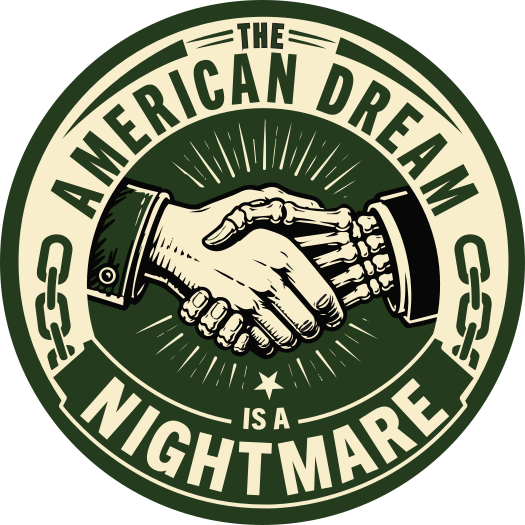
A bold circular union-style badge showing a worker shaking hands with a skeletal figure beneath the words The American Dream Is a Nightmare.

The canary: When productive work no longer reliably creates security, the promise is breaking.

WORK SHOULD PROVIDE A LIFE POWER MUST ANSWER TO PEOPLE OPPORTUNITY CANNOT BE FOR SALE THE RULES CAN BE REWRITTEN

This is not a eulogy. It is an alarm.

Wake up.

We were promised that hard work would build a life.

That if we showed up, played by the rules, learned a trade, earned a degree, raised a family, started a business, or gave our time to something larger than ourselves, we would have a fair chance.

Not a guarantee of wealth. A chance.

A home we could afford. Food on the table. Healthcare when we were sick. Time with the people we love. Enough left over to breathe. A future our children could believe in.

But look around.

Paychecks disappear into rent, groceries, childcare, insurance, medicine, and debt. Teachers cannot afford to live where they teach. Parents miss their children because one job is no longer enough. Young people begin adulthood already owing years of their future.

Millions are doing everything they were told to do and still cannot build a stable life.

That is not personal failure.
That is a warning.

The dream did not disappear on its own.

It was rewritten—slowly, quietly, systematically.

  • One monopoly approved.
  • One union broken.
  • One competitor bought and buried.
  • One public service turned into a profit center.
  • One tax advantage protected.
  • One wage suppressed.
  • One home converted into an investment vehicle.
  • One law shaped by those wealthy enough to purchase access.

None of these decisions destroyed the American Dream by themselves. Together, they changed who the economy serves.

Wealth became influence.

Influence shaped the rules.

The rules created more wealth.

This is not about resenting success. It is about rejecting a rigged definition of it.

Enterprise should reward people who create, build, invent, serve, and take risks. It should not reward those who eliminate competition, suppress wages, manufacture scarcity, purchase political influence, or extract value from communities they did nothing to build.

The problem is not that some people have more.
The problem is that accumulated wealth can buy the power to decide who gets less.

We refuse to accept survival as prosperity.

A full-time job should provide more than exhaustion. It should provide a life: shelter, food, healthcare, rest, time to care for others, the ability to save, and the dignity of growing older without fear.

These are not luxuries. They are the foundation of a functioning society.

An economy is not successful because it produces billionaires.
It is successful when the people who keep it running can live with security, dignity, and hope.

Power does not check itself. People do.

Every right workers possess was demanded. Every monopoly ever broken was once considered untouchable. Every unjust system once defended itself as natural, necessary, and permanent.

It was none of those things.

It was built by people. It was maintained by people. And it was changed by people.

The American Dream was never a gift from the powerful. It was built by workers, families, immigrants, teachers, caregivers, tradespeople, artists, farmers, entrepreneurs, and communities that believed tomorrow could be better.

It still belongs to us.

But only if we are willing to reclaim it.

Wake up. See the system. Rewrite the rules. Reclaim the dream.

The feedback loop

The rules don’t rig themselves.

Concentrated wealth becomes dangerous when it can be converted into concentrated power—then used to protect and multiply itself.

01

Wealth

Assets, ownership, and accumulated capital create leverage far beyond a paycheck.

02

Influence

Lobbying, political spending, market control, media ownership, and privileged access.

03

Rules

Laws, tax structures, regulation, labor policy, and public priorities bend toward the powerful.

04

More wealth

Advantages compound. Competition shrinks. The ladder gets pulled higher.

The cycle breaks when people can see it, name it, and organize around specific changes.

The canary in the coal mine

When work stops providing a life, the system is failing its purpose.

This movement begins with the experience millions already know: working more, owning less, postponing life, and being told the problem is personal.

01

Housing

A home becomes an investment class before it remains a place to live.

02

Healthcare

Getting sick threatens both the body and the family’s financial future.

03

Childcare

Parents face impossible tradeoffs between earning a living and raising a family.

04

Debt

Education, emergencies, and basic needs borrow against years not yet lived.

05

Time

More jobs and longer hours consume the very life work is meant to support.

A standard worth fighting for

Not equal outcomes.
Equal human worth under the rules.

01

Work should provide a life.

Full-time work should create a realistic path to security, health, rest, family, and a future.

02

Opportunity cannot be inherited away.

Existing wealth should not permanently close markets, capture institutions, or pull the ladder up.

03

Enterprise should create value.

Reward invention and service—not monopoly, artificial scarcity, wage suppression, or extraction.

04

Power must remain accountable.

No donor, corporation, platform, agency, or individual should operate beyond meaningful scrutiny.

05

Democracy is not for sale.

Economic power should never purchase more citizenship, more access, or more control over public rules.

06

People can rewrite what people wrote.

Concentrated power is not natural law. Institutions can be rebuilt around broad opportunity.

Be clear about the target

Not against success.
Against rigging.

We defend

  • Creation
  • Risk
  • Innovation
  • Fair competition
  • Small enterprise
  • Shared prosperity

We reject

  • Capture
  • Monopoly
  • Extraction
  • Purchased access
  • Permanent advantage
  • Survival sold as prosperity

Where pressure becomes progress

Rebuild the guardrails.

A movement needs places to apply pressure. These are the institutions that keep private power from becoming permanent rule.

01

Antitrust

Protect competition and stop dominance from becoming destiny.

02

Campaign finance

Reduce the ability to purchase political access and public policy.

03

Transparency

Make influence, ownership, lobbying, and conflicts visible.

04

Labor power

Give working people meaningful leverage over wages and conditions.

05

Independent courts

Keep law accountable to principle rather than money or faction.

06

Free press

Fund the scrutiny that concentrated power works hardest to avoid.

07

Competitive markets

Make room for challengers, builders, and local ownership.

08

Free elections

Protect the public’s peaceful power to remove and replace leaders.

This begins with awareness. It cannot end there.

Wake up.
Then help someone else see it.

Join the first wave of people shaping the language, stories, research, artwork, and actions of this movement.